
Key learnings from Briefing Paper https://services.parliament.uk/bills/2019-21/agriculture.html https://publications.parliament.uk/pa/bills/cbill/58-01/0007/20007.pdf
- Environmental Land Management (ELM) schemes will be a mainstay of future farm support. Key change is phasing out of Direct Farm Support (according to how much land they own (rather than how much they produce, to avoid incentivising overproduction)) to Payment for Public Goods. Phasing out of Direct Payments from 2021-2027 while ELMs take over.
- “Farming organisations and environmental groups both broadly support the new ‘public money for public goods’ approach to future farm support schemes. Farmers however want food production itself to be considered a public good and for food production to be central to the Bill. This Bill (unlike the previous Bill) requires Ministers to have regard to the need to encourage the production of food in England, in an environmentally sustainable way. The NFU has welcomed recognition in this Bill that “food production and caring for the environment go hand- in-hand”” (pg 8)
- “Farmers and environmental groups are also concerned that there are no commitments to maintaining food and animal welfare standards for imports under new trade deals. Some 62 farm and environment organisations wrote to the Prime Minister on 27 January calling for legislation to underpin Government commitments not to reduce such standards in future trade deals” (pg 8)
- This was the content of the proposed amendment 16, voted overwhelmingly against on On October 12th 2010 by Conservative MPs, seemingly contradicting their own manifesto (REF?) pledge “In all of our negotiations, we will not compromise on our high environmental protection, animal welfare, and food standards” https://votes.parliament.uk/Votes/Commons/Division/871
- In 2018, payments from the EU’s Common Agricultural Policy (CAP) made up 70% of farmers’ total income on average across the UK (table 2, pg 13)
- 2020 funding will remain equal to CAP funding (around £3billion)
- Longer-term funding plans will come into place, the first plan to run 2021-2029 and future plans to cover no less than 5 years funding so farmers can plan ahead
- Financial incentivises for environmental protection including tree planting; school and touristic engagement with the environment; peatland restoration; rearing rare breeds; fertiliser reduction (Table 1 pg 21). Under CAP, direct payments and rural development grants across the UK have already been linked to incentivising or requiring farm management/activities which enhance or protect the environment as well as promoting the rural economy. For example, 30% of the direct payment can only be secured through meeting ‘greening’ requirements. To comply, farmers are required to implement greening rules which cover three areas – crop diversification, Ecological Focus Areas, and measures to maintain permanent grassland. Further, each part of the UK operates agri-environment schemes as part of their Rural Development Programmes. In the last CAP reform process (2013), the UK Government at the time argued that “rewarding farmers for the environmental goods they provide is much better use of taxpayers’ money than providing direct subsidy.” However, current farm support up to now has still largely been based on the area of land farmed.
- Administration and enforcement???
- Clause 17 introduces a new requirement on the Secretary of State to report to Parliament on UK food security at least once every five years. The report is to contain “an analysis of statistical data”. The clause sets out five areas that the report “may” include, “among other things”: global food availability; supply sources for food; the resilience of the supply chain; household expenditure on food; and food safety and consumer confidence in food (pg 46)
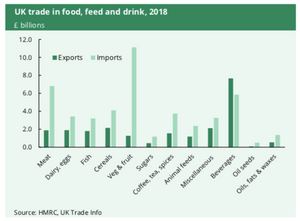
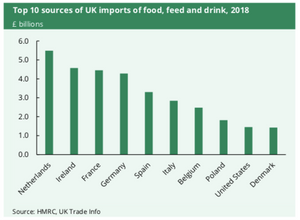
- “The UK is approximately 61% self-sufficient in all foods and 75% sufficient in indigenous foods” (REF 126 embedded in this doc = Defra and Devolved Administrations, Agriculture in the UK 2018, June 2019, table 14.1 p98. Food Production to Supply Ratio is calculated as the farm-gate value of raw food production (including for export) divided by the value of raw food for human consumption)” (https://assets.publishing.service.gov.uk/government/uploads/system/uploads/attachment_data/file/848641/AUK_2018_09jul19a.pdf
- According to the NFU, at the current rate of production, if the UK tried to survive solely on food produced in the UK from 1 January, it would run out in the second week of August” (REF 127 embedded in this doc = NFU, NFU calls for government commitment on British food self-sufficiency, 11 August 2019) https://www.nfuonline.com/news/latest-news/nfu-calls-for-government-commitment-on-british-food-self-sufficiency/
- DEFRA is developing a National Food Strategy, to be released earliest Jan 2021 https://www.gov.uk/government/publications/developing-a-national-food-strategy-independent-review-2019/developing-a-national-food-strategy-independent-review-2019-terms-of-reference
- ??? don’t understand! Clause 27: The Government aims to strengthen fairness in the supply chain. The Groceries Code Adjudicator (GCA) was established in 2013 to enforce the Groceries Supply Code of Practice between grocery retailers and their direct suppliers. However, the majority of farmers do not supply supermarkets directly. They are therefore not covered by the GCA and since it has been established there have been calls from farming unions to address fairness in this part of the supply chain in some way.
 South Kent Coast Food Partnership